
Class 4 Have Has Had Grammar Worksheet

Class 4 Have Has Had Grammar Worksheet
Have, Has, Had Heroes: Mastering Auxiliary Verbs for Class 4
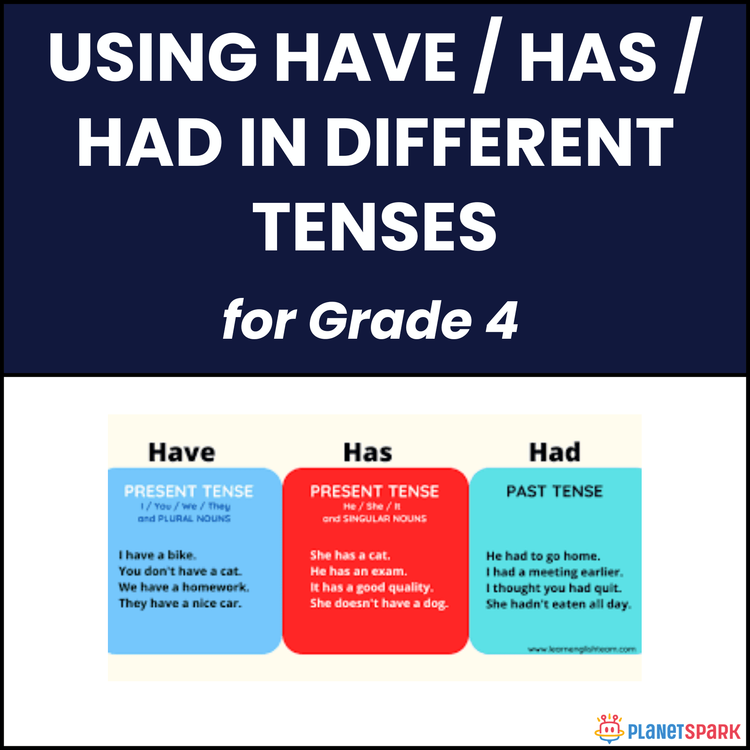
This Grade 4 English worksheet, Using Have / Has / Had in Different Tenses, helps students confidently apply correct auxiliary verb forms based on subject and time context. Through structured and progressive exercises, learners strengthen their understanding of subject–verb agreement and perfect tense construction.
Why Using Have / Has / Had in Different Tenses Matters in Grammar?
Understanding how to use have, has, and had correctly helps students:
1. Form accurate Present Perfect and Past Perfect sentences.
2. Maintain correct subject–verb agreement.
3. Avoid common mistakes like “I has” or “they has.”
4. Improve clarity and accuracy in paragraph writing.
What’s Inside This Worksheet?
This worksheet includes five focused grammar activities:
Exercise 1 – Multiple Choice Questions
Students choose the sentence that correctly uses have, has, or had.
Exercise 2 – True or False
Learners identify whether each sentence correctly uses have, has, or had.
Exercise 3 – Fill in the Blanks
Students complete sentences using have, has, or had according to context clues.
Exercise 4 – Sentence Rewriting
Students correct only the auxiliary verb (have/has/had) without changing the main verb.
Exercise 5 – Paragraph Completion
A contextual paragraph where students maintain tense consistency using correct auxiliary forms throughout.
Answer Key (For Parents & Educators)
Exercise 1 – Multiple Choice
1. Nikhil has organized the bookshelf neatly.
2. The swimmers have practiced for weeks.
3. Kavya had locked the gate before sunset.
4. The puppy has chewed the slipper.
5. Aarini had watered the plants before leaving home.
6. The musicians have tuned their instruments.
7. Farhan has repaired the broken chair.
8. The hikers had reached the peak before noon.
9. Diya and Mehul have arranged the chairs.
10. Ritesh had completed the sketch before class began.
Exercise 2 – True / False
1. True
2. True
3. False
4. True
5. True
6. False
7. True
8. True
9. False
10. True
Exercise 3 – Fill in the Blanks
1. has
2. have
3. had
4. has
5. have
6. has
7. had
8. have
9. has
10. have
Exercise 4 – Sentence Rewriting
1. Kavish has completed his science project.
2. Meher has visited the museum.
3. Aanya has prepared the meal.
4. The players have won the match.
5. The children have finished the race.
6. The teachers have arranged the books.
7. The kitten has drunk the milk.
8. Pranav has chosen the blue bag.
9. Ruhan has written a speech.
10. Samaira has cleaned her cupboard.
Exercise 5 – Paragraph Completion
Aarav has always enjoyed working on creative projects.
He has had a strong interest in building science models since Class 3.
Last year, he had taken part in the annual school exhibition and had won first prize.
Since then, he has worked even harder to improve his skills.
His sister has helped him many times with charts and neat labeling.
They have prepared several models together at home.
By the time this year’s exhibition began, Aarav had already completed most of his project work.
He had arranged his display carefully before the judges arrived.
His friends have admired his ideas, and the principal has appreciated his effort.
Aarav felt proud because he had achieved his goal and had learned valuable lessons about patience and teamwork through practice.
This worksheet is ideal for revision practice, grammar strengthening, and classroom reinforcement for Grade 4 learners.
Empower your child to confidently use have, has, and had in perfect tense sentences with structured grammar practice.
Frequently Asked Questions
In Class 4 grammar, have is used with I, you, we, and they, has is used with he, she, and it, and had is used to show past tense in CBSE English worksheets.
Many early learners mix up have and has because they forget to match the verb with the subject, so regular practice in a Class 4 grammar worksheet improves subject-verb agreement skills.
Parents can encourage children to form simple daily-life sentences using have, has, and had, which strengthens understanding through structured English worksheet revision and CBSE English practice.