
Class 4 English Grammar Worksheet on Compound Words

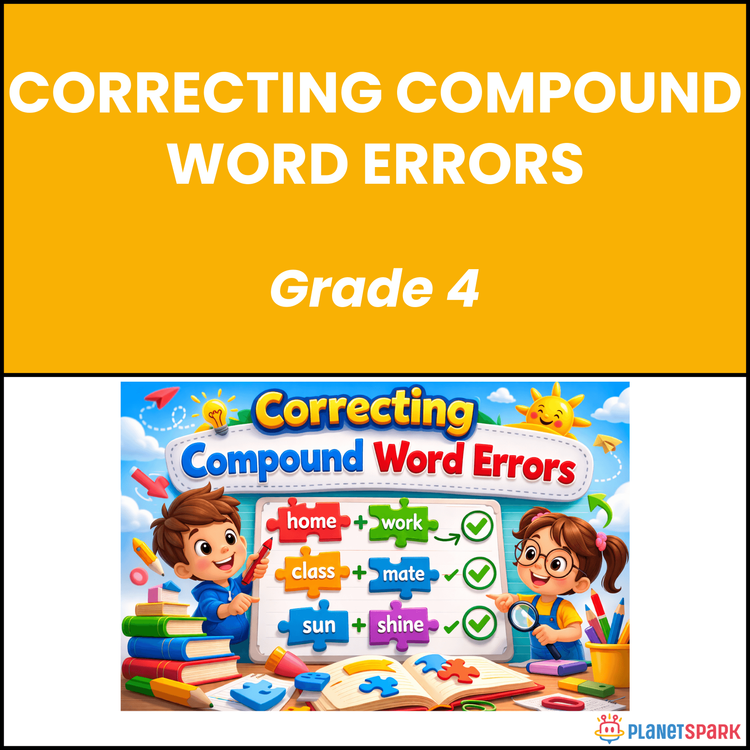
Class 4 English Grammar Worksheet on Compound Words
Two Words, One Meaning: Correcting Compound Word Errors for Grade 4
This Grade 4 worksheet is thoughtfully designed to help students master compound words—words formed by joining two smaller words together to create a new meaning. By exploring common compound words in engaging and varied contexts, this resource empowers young learners to recognize, understand, and correctly spell these important vocabulary words. Through a series of interactive exercises, students will build the confidence to identify and use compound words accurately in their writing.
Why Mastering Compound Words Matters in Grammar?
For Grade 4 students, correctly understanding and spelling compound words is essential for developing strong reading and writing skills. This topic is important because:
1. Compound words appear frequently in everyday reading materials and textbooks.
2. Mastering them helps students understand how words can combine to create new meanings.
3. It builds a strong foundation for vocabulary expansion and spelling accuracy.
What's Inside This Worksheet?
This worksheet includes five engaging activities to build a strong foundation in compound words:
Exercise 1 – True or False
Students read sentences and decide if the compound word is written correctly (as one word, two words, or hyphenated). This quick assessment helps identify common spelling misconceptions right from the start.
Exercise 2 – Sort the Words
This critical thinking exercise asks students to analyze words and sort them into two categories: "Compound Words" and "Non-Compound Words." This reinforces the definition of a compound word and sharpens their word analysis skills.
Exercise 3 – Fill in the Blanks
Students choose the correct compound word from two options to complete each sentence. This helps them understand how compound words are formed and used in context.
Exercise 4 – Multiple Choice Questions
This classic exercise presents sentences with a missing word, offering multiple compound word options. Students must select the correct one, building their recognition and spelling skills.
Exercise 5 – Sentence Rewriting
Each sentence in this exercise contains an incorrectly written compound word (either split incorrectly, hyphenated incorrectly, or joined incorrectly). Students must identify the error and rewrite the sentence with the correct compound word form, building essential editing and proofreading skills.
Answer Key
Exercise 1 – True or False
1. True
2. True
3. False (The playground was full of children.)
4. False (She wore a beautiful butterfly necklace.)
5. False (The notebook was placed on the desk.)
6. True
7. False (The toothbrush is in the bathroom.)
8. False (The sunlight came through the window.)
9. True
10. True
Exercise 2 – Sort the Words into Compound Words and Non-Compound Words
Compound Words: Snowman, Basketball, Playground, Butterfly, Notebook, Toothpaste, Toothbrush, Sunlight, Rainbow, Classroom
Non-Compound Words: Snow, Man, Basket, Ball, Play, Ground, Butter, Fly, Note, Book, Tooth, Paste, Brush, Sun, Light, Rain, Bow, Class, Room
Exercise 3 – Fill in the Blanks (Word from Page 5)
1. Dragonfly
2. Notebook
3. Daydream
4. Passport
5. Postcard
6. Hairband
7. Brainwash
8. Scarecrow
9. Raindrop
10. Basketball
Exercise 4 – Multiple Choice Questions
1. b) Backbone
2. b) Snowball
3. a) Bedroom
4. c) Dishpan
5. d) Sunflower
6. c) Earring
7. d) Forgive
8. a) Highway
9. b) Anytime
10. d) Buttermilk
Exercise 5 – Sentence Rewriting
1. Raj put his lunch in the lunchbox and went to school.
2. The teacher wrote on the blackboard during the lesson.
3. I kept my shoes in the shoebox by the door.
4. The door opened like a thunderclap.
5. She ate a delicious blueberry for breakfast.
6. The plates are kept in the cupboard after washing.
7. Jaya said goodbye to everyone before leaving.
8. The injured man sat in his wheelchair.
9. The house is designed to be fireproof.
10. The fisherman caught a large fish in the lake.
Help your child master compound words and become a confident speller with a Free 1:1 Communication Skills Trial Class at PlanetSpark.
Frequently Asked Questions
Compound words are formed by combining two smaller words, such as "toothbrush" or "basketball." Practice can help students recognize and use them in sentences.
They may confuse them with simple words or misplace the hyphen when writing them. Reinforced practice and word recognition can help.
By providing exercises that ask students to combine smaller words into compound words and use them in context.