
Class 4 Grammar Worksheet on Its vs. It’s Confusion

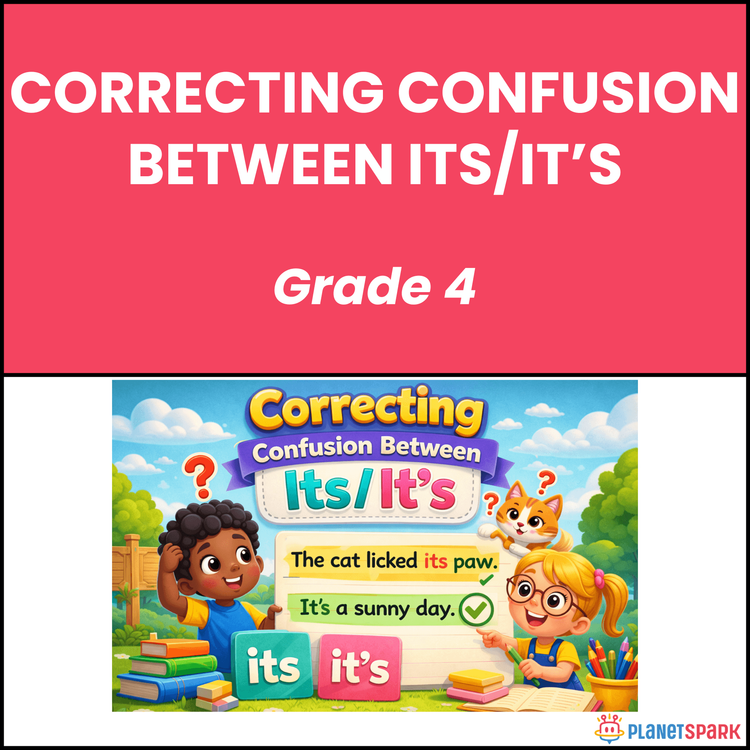
Class 4 Grammar Worksheet on Its vs. It’s Confusion
Possessive or Contraction? Mastering Its vs. It's for Grade 4
This Grade 4 worksheet is expertly designed to help students master one of the most commonly confused word pairs in English: "its" and "it's." By breaking down the simple but crucial difference—"its" shows possession (belonging to it), while "it's" is a contraction for "it is" or "it has"—this resource provides a clear and structured path to grammatical accuracy. Through engaging, real-world examples, young learners will gain the confidence to use these words correctly in their writing.
Why Mastering Its vs. It's Matters in Grammar?
For Grade 4 students, understanding the difference between "its" and "it's" is a key milestone in developing strong writing skills. This topic is important because:
1. It clarifies a high-frequency error that appears in both casual and formal writing.
2. It reinforces the important concepts of possessive pronouns and contractions side by side.
3. It enhances the overall clarity and professionalism of a student's written communication.
What's Inside This Worksheet?
This worksheet includes five targeted activities to build a deep and lasting understanding:
Exercise 1 – True or False
Students read sentences and decide if the usage of "its" or "it's" is correct. This quick assessment helps identify common misconceptions right from the start.
Exercise 2 – Multiple Choice Questions
Students choose the correct word from two options ("its" or "it's") to complete each sentence. This classic format reinforces the possessive vs. contraction rule in a straightforward way.
Exercise 3 – Fill in the Blanks
Students select the appropriate word from a given pair to complete a sentence. This activity encourages active application of the grammar rule in various contexts.
Exercise 4 – Underline and Rewrite
Each sentence in this exercise contains an incorrect usage of "its" or "it's." Students must identify the error and rewrite the sentence correctly, building essential editing and proofreading skills.
Exercise 5 – Paragraph Writing
This comprehensive exercise presents a paragraph about a school science fair with blanks. Students must fill in each blank with the correct word ("its" or "it's"), demonstrating their mastery in a connected, real-world writing task.
Answer Key
Exercise 1 – True or False
1. False (It's raining in Mumbai today.)
2. True
3. True
4. True
5. False (It's been a long week.)
6. True
7. True
8. False (The bird spread its wings.)
9. False (It's a cold morning in Pune.)
10. False (The cat cleaned its paws.)
Exercise 2 – Multiple Choice Questions
1. b) it's
2. a) its
3. b) it's
4. a) its
5. a) its
6. a) its
7. b) it's
8. b) it's
9. b) it's
10. a) its
Exercise 3 – Fill in the Blanks (Word from Page 6)
1. it's
2. its
3. its
4. It's
5. it's
6. It's
7. its
8. its
9. it's
10. its
Exercise 4 – Underline and Rewrite
1. The company announced its annual results.
2. It's been an honor to receive this award.
3. The team celebrated its victory with enthusiasm.
4. The building had its windows cleaned.
5. It's likely to rain later today.
6. It's obvious that she is very talented.
7. The cat cleaned its fur meticulously.
8. It's a beautiful day to go for a hike.
9. The school renovated its library over the summer.
10. The machine performed its task efficiently.
Exercise 5 – Paragraph Writing
At the school science fair in Pune, it's exciting to see so many projects. Each robot showed its special features, and it's amazing how students explained their ideas confidently. One model volcano surprised everyone when it suddenly erupted with foam. The solar car moved on its own using sunlight. The computer displayed its screen brightly as visitors asked questions. By the end of the day, it's clear that hard work truly pays off.
Help your child master tricky word pairs like its/it's and become a confident writer with a Free 1:1 Communication Skills Trial Class at PlanetSpark.
Frequently Asked Questions
Its shows possession (e.g., the cat licked its paw), while "it's" is a contraction for "it is" or "it has." Teaching with examples helps.
The confusion arises because "it's" sounds like a possessive, but it's actually a contraction. Practice with sentences helps clarify the difference.
Activities like sentence completion and quizzes can help children identify the correct usage of "its" and "it's."