
Class 7 English Worksheet on Advanced Plot Structure

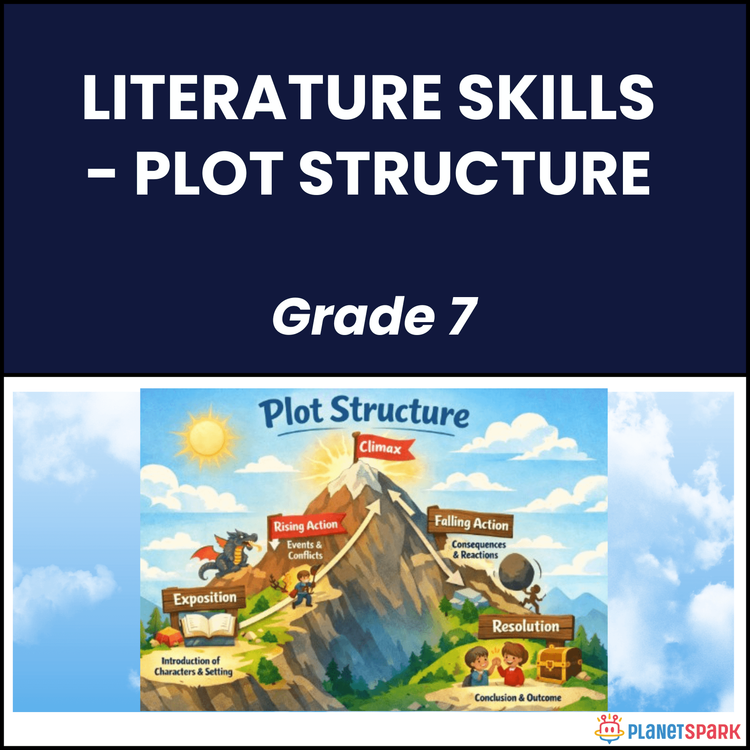
Class 7 English Worksheet on Advanced Plot Structure
Story Arcs Unfold: Plot Elements for Class 7
This Grade 7 literature skills worksheet helps learners explore advanced elements of plot structure. Students practice identifying plot terms in multiple-choice questions, completing fill-in-the-blank tasks, judging statements in true/false exercises, underlining plot elements and circling actions in sentences, and analyzing a passage to identify exposition, rising action, climax, foreshadowing, and supporting characters. These varied activities build narrative comprehension, critical thinking, and confidence in CBSE/IB English classrooms.
Why Plot Structure Matters in Literature?
1. It helps students understand how stories are built and progress.
2. It teaches key elements like exposition, climax, resolution, and conflict.
3. It develops analytical skills by connecting plot elements to character growth.
4. It strengthens storytelling ability and prepares learners for advanced writing tasks.
What’s Inside This Worksheet?
🧠 Exercise 1 – Multiple Choice Questions
Students identify plot terms like protagonist, antagonist, climax, and conflict.
✏️ Exercise 2 – Fill in the Blanks
Learners complete sentences using plot-related terms.
✔️ Exercise 3 – True or False
Students judge statements about plot elements and their functions.
🔄 Exercise 4 – Underline & Circle
Learners underline plot elements and circle action words in sentences.
📝 Exercise 5 – Passage Analysis
Students identify exposition, rising action, climax, foreshadowing, and supporting characters in a short passage.
✅ Answer Key (For Parents & Educators)
Exercise 1 – Multiple Choice
1. b) protagonist
2. c) antagonist
3. b) climax
4. a) rising action
5. b) exposition
6. c) resolution
7. b) foreshadowing
8. c) flashback
9. a) subplot
10. a) conflict
Exercise 2 – Fill in the Blanks
1. plot
2. sequence events
3. beginning
4. falling action
5. closes
6. surprise ending
7. parallel episode
8. suspense build
9. setting place
10. internal conflict
Exercise 3 – True or False
1. True
2. False
3. True
4. False
5. True
6. False
7. True
8. True
9. False
10. False
Exercise 4 – Underline Plot Element / Circle Action
1. Plot element: conflict / Action: faces
2. Plot element: rising action / Action: builds
3. Plot element: climax / Action: wins
4. Plot element: flashback / Action: shows
5. Plot element: subplot / Action: adds
6. Plot element: antagonist / Action: challenges
7. Plot element: protagonist / Action: solves
8. Plot element: foreshadowing / Action: hints
9. Plot element: conflict / Action: grows
10. Plot element: climax / Action: changes
Exercise 5 – Passage Analysis
Exposition: Ravi plays a cricket match in the rain at school.
Rising Action: He feels nervous but becomes confident as the game continues.
Climax: He hits the winning run at the most intense moment.
Foreshadowing: A hint showed he practiced daily.
Supporting Character: His friend supports him in the game.
Help your child master plot structure and storytelling with engaging Class 7 practice.
Frequently Asked Questions
Advanced plot structure refers to how a story is organized using elements like exposition, rising action, climax, and resolution, helping Class 7 students build stronger storytelling skills.
A well-designed English worksheet helps students break down each part of a story and practice identifying structure in a clear and engaging way.
Early learners often find it difficult because they read stories as a whole and need guided grammar worksheets to recognize each stage separately.