
Class 7 Worksheet on Argument and Evidence

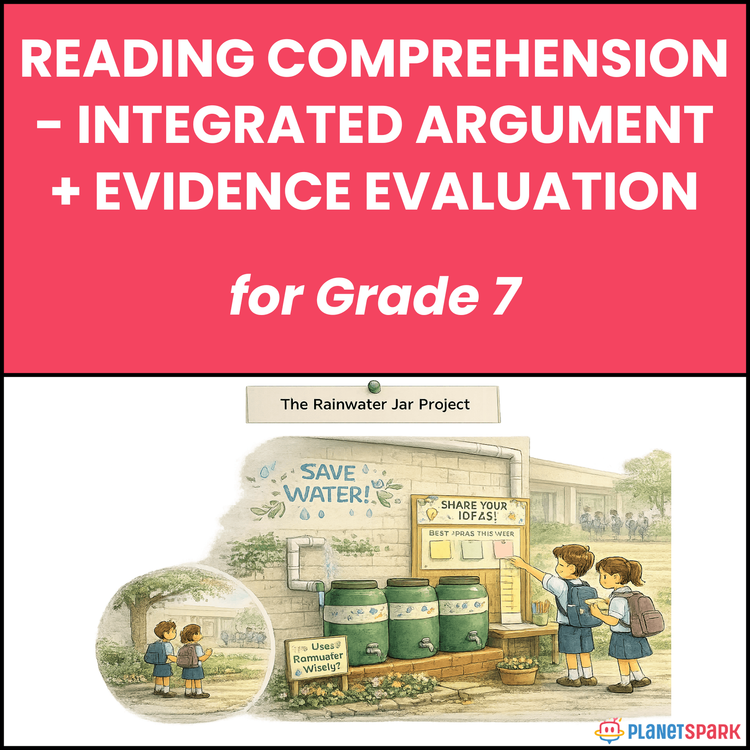
Class 7 Worksheet on Argument and Evidence
Master Argument and Evidence Evaluation: Grade 7 Reading Comprehension Worksheet
This Grade 7 worksheet is designed to help students develop strong reading comprehension skills by analyzing arguments, evaluating evidence, and supporting conclusions using details from the text. With a variety of engaging exercises, this worksheet provides essential practice for young learners.
In this worksheet, students will focus on understanding how arguments are supported by evidence and how logical reasoning strengthens ideas, with activities such as:
✔️ Multiple choice questions to identify the best argument and supporting evidence from the story.
✔️ Fill-in-the-blank exercises using important words from the passage.
✔️ True/False statements to test understanding of facts and logical conclusions.
✔️ Sentence completion to explain arguments using textual support.
✔️ Paragraph completion to strengthen analytical reading and evidence-based reasoning.
This worksheet helps students understand how to judge whether an idea is practical, useful, and supported by clear proof, improving comprehension, critical thinking, and reasoning skills.
Perfect for strengthening core English reading skills in a fun, structured, and practical way!
🔹 Answer Key (for parents and educators)
Exercise 1 – Choose the Best Answer:
1. a) She wanted students to save water and help the garden.
2. b) They thought the jars would be dirty and unused.
3. b) Saving small amounts of water can protect many plants.
4. b) They could reduce the project cost.
5. b) She offered waterproof labels.
6. a) Students worked together.
7. c) He liked the practical and useful plan.
8. c) Strong wall space and room for jars.
9. c) Small actions can create environmental change.
10. a) They showed clear results and progress.
Exercise 2 – Fill in the Blanks:
1. rainwater
2. charts
3. labels
4. drums
5. teacher
6. Wednesday
7. plants
8. results
9. walls
10. garden
Exercise 3 – True or False:
1. False
2. True
3. True
4. False
5. True
6. True
7. False
8. True
9. False
10. False
Exercise 4 – Complete Each Sentence:
1. Kavya suggested the Rainwater Jar Project because she wanted students to save water and protect the garden using a practical system.
2. Kavya remembered her aunt’s words because she understood that saving small amounts of water every day can protect many plants over time.
3. The measuring charts helped students record how much water was collected each week and showed clear results.
4. Students learned the value of conservation because they saw how saving rainwater could protect plants and reduce unnecessary tap usage.
5. Some students doubted the idea because they thought the jars would become dirty and nobody would remember to use them.
6. Dev supported the plan by suggesting measuring charts beside the jars so students could track water collection.
7. Mr Verma helped by liking the idea and asking them to prepare a simple plan for the project.
8. Simran offered help after she listened carefully and gave extra waterproof labels from home.
9. Old storage drums were useful because they reduced the project cost and could be reused instead of buying new jars.
10. Students started helping the garden when the Rainwater Jar Project became a class effort and everyone supported it.
Exercise 5 – Complete the Passage:
1. rainwater
2. jars
3. charts
4. labels
5. teacher
6. Wednesday
7. plants
8. results
9. walls
10. garden
Help your child strengthen argument and evidence evaluation skills and build confidence in evidence-based reading with expert-guided learning.
Book a free trial!
Frequently Asked Questions
They help students identify claims and supporting proof, building stronger reasoning and analytical reading comprehension skills.
They should find the main claim, supporting examples, and whether the evidence makes the writer’s point strong and believable.
It strengthens logic, helps students question ideas, and improves their ability to write supported answers in comprehension tasks.