
Class 7 Worksheet on Inference and Evidence

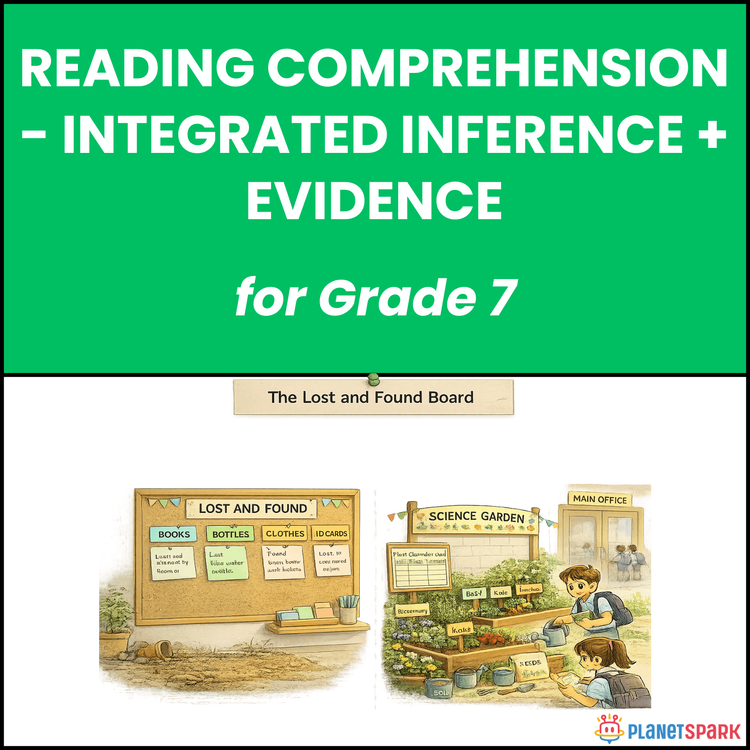
Class 7 Worksheet on Inference and Evidence
Master Inference and Evidence: Grade 7 Reading Comprehension Worksheet
This Grade 7 worksheet is designed to help students develop strong reading comprehension skills by identifying inferences and supporting them with evidence from the text. With a variety of engaging exercises, this worksheet provides essential practice for young learners In this worksheet, students will focus on understanding how to read between the lines and support answers using clues from the passage, with activities such as:
✔️ Multiple choice questions to identify the best inference based on the story.
✔️ Fill-in-the-blank exercises using keywords from the passage.
✔️ True/False statements to test understanding of evidence from the text.
✔️ Sentence completion to explain ideas using textual support.
✔️ Paragraph completion to practice inference and evidence in context.
This worksheet helps students understand how to connect details from a passage with logical conclusions, improving comprehension, critical thinking, and evidence-based reasoning.
Perfect for strengthening core English reading skills in a fun, structured, and practical way!
🔹 Answer Key (for parents and educators)
Exercise 1 – Choose the Best Answer:
1. b) He wanted students to find lost items easily.
2. a) They thought students would ignore the board.
3. a) Honesty grows stronger through trust.
4. a) It could reduce the project cost.
5. b) He offered pins and marker pens.
6. b) Students worked together.
7. c) She liked the practical and useful plan.
8. b) An empty wall and an old soft board.
9. c) Simple systems and honesty solve problems.
10. c) They kept the board neat and easy to use.
Exercise 2 – Fill in the Blanks:
1. lost
2. noticed
3. labels
4. board
5. teacher
6. Friday
7. pins
8. honesty
9. change
10. wall
Exercise 3 – True or False:
1. False
2. True
3. True
4. False
5. True
6. True
7. False
8. True
9. False
10. False
Exercise 4 – Complete Each Sentence:
1. Rehan suggested the Lost and Found Board because he wanted students to find lost items quickly and honestly.
2. Rehan remembered his father’s words because he understood that trust and honesty help solve daily problems.
3. The category labels helped students keep the board neat and easy to use.
4. Students learned the value of honesty because they saw how trust made the system work better.
5. Some students doubted the idea because they thought students would ignore the board.
6. Sana supported the plan by suggesting labels for item types and using old chart paper.
7. Mrs Nair helped by asking them to prepare a simple plan and supporting the idea.
8. Vikram offered help after he saw the class listening carefully and understanding the idea.
9. The old soft board was useful because it could be cleaned and reused.
10. Students started using the board when it became a class effort and everyone supported it.
Exercise 5 – Complete the Passage:
1. lost
2. noticed
3. wall
4. board
5. labels
6. Friday
7. teacher
8. pins
9. honesty
10. change
Help your child strengthen inference skills and build confidence in evidence-based reading with expert-guided learning.
Book a free trial!
Frequently Asked Questions
They teach students to combine text clues with proof, improving logical thinking and stronger Class 7 English answer writing.
Inference means understanding hidden ideas, while evidence means using exact details from the passage to support that understanding.
They should practice finding clues first and then matching those clues with lines from the text for stronger answers.